


 66 / 302

Erwin Blumenfeld. Historic shots include
Irving Penn’s portray of the Illusionniste
coat from the Autumn-Winter 1950
Oblique line with its huge collar and
broad sleeves, accentuated by the
photographer’s use of daylight and the
subtlety of the studio to capture these
dramatic images. While black and white
photographs abstract the clothing to
the essentials in terms of structure
and geometry rather than colour and
material, other photographers captured
the mood of the times with authentic
settings in the City of Light, focusing on
the couturier’s intrinsically Parisian flair.
Clifford Coffin’s shot of a backlit pose
in profile highlighted the bustle of the
Cocotte dress while the vertical lines of
the window and the slant of the broom
accentuate the garment’s geometry.
Henry Clarke’s photograph of a hat,
a glass of champagne, a mirror and
the model Dovima, was combined
to epitomise chic at the restaurant
Lapérouse, while the romantic and
theatrical vision of Dior’s evening
and ball gowns were captured by the
likes of Willy Maywald, Louise Dahl-
Wolfe and Norman Parkinson.
In ‘Portraits of Christian Dior’, we
get an insight into the couturier’s
character and pose. Having lost
his childhood home in the 1930s,
following the Wall Street crash of
1929, Christian Dior was known to
attain a certain pose in photographs
as if to demonstrate his success and
convey his values. His portraits by
Brassaï and Cecil Beaton were often
taken in the setting of his homes
such as the apartment on rue Royale
or the town house on boulevard
Jules-Sandeau, where the décor revealed
key aspects of the man and his tastes
including his love of art. Dior is said to
have portrayed an image of a simple
man, where his intentionally casual pose
of smoking a cigar and sporting a blazer,
sitting on a low wall or playing cards in his
garden at cocktail time was captured by
Lord Snowdon and Louise Dahl-Wolfe.
However, there is one portrait by Yousuf
Karsh that reveals his dual personality
or the “other himself” as he describes it,
where the photographer playing on his
signature use of contrasting shadow and
light, presents two men: the couturier
playing a role in the limelight and the shy
man hiding in the shadows who does not
like to be exposed, “incapable of playing
that role.”
The following pages reveals the artistic
ways in which the great photographers of
the day saw Dior through their lenses and
how their photographic work harmonised
with the distinguishing characteristics
of the fashion house. Using Dior’s
desire of a nostalgic eighteenth-century
atmosphere as the perfect backdrop of
subtle elegance for his dresses, Serge
Balkin captured the famous New Look
collection for the first story that
Vogue
devoted to the new couturier. Since
then, photographers from Louise Dahl-
Wolfe to Patrick Demarchelier have
used this couture house ‘photo studio’
to compose images with dual messages,
superimposing day-to-day couture life
over the presentation of new fashion.
While Louise Dahl-Wolfe offset the
slender silhouette of a Dior model
against the stalwart line of saleswomen
waiting for buyers, Willy Maywald and
Patrick Demarchelier revealed what goes
on behind the scenes is as important as
what occurs at the front of the fashion
house and Loomis Dean illustrated the
never-ending work of fashion in tirelessly
launching new designs by placing the
models around a ladder.
We then move from fashion into beauty
for a moment where we learn in 1960
the House of Dior’s advertisement
for lipstick marked their first use of
photography.The alluring black and white
print by Studio Harcourt, the renowned
celebrity portrait studio, portrayed a
woman’s face hidden in the shadow of
an elegant dark hat. All that could be
seen is the oval hat and her sensuous
lips, which began a revolution in lipstick
bite
books
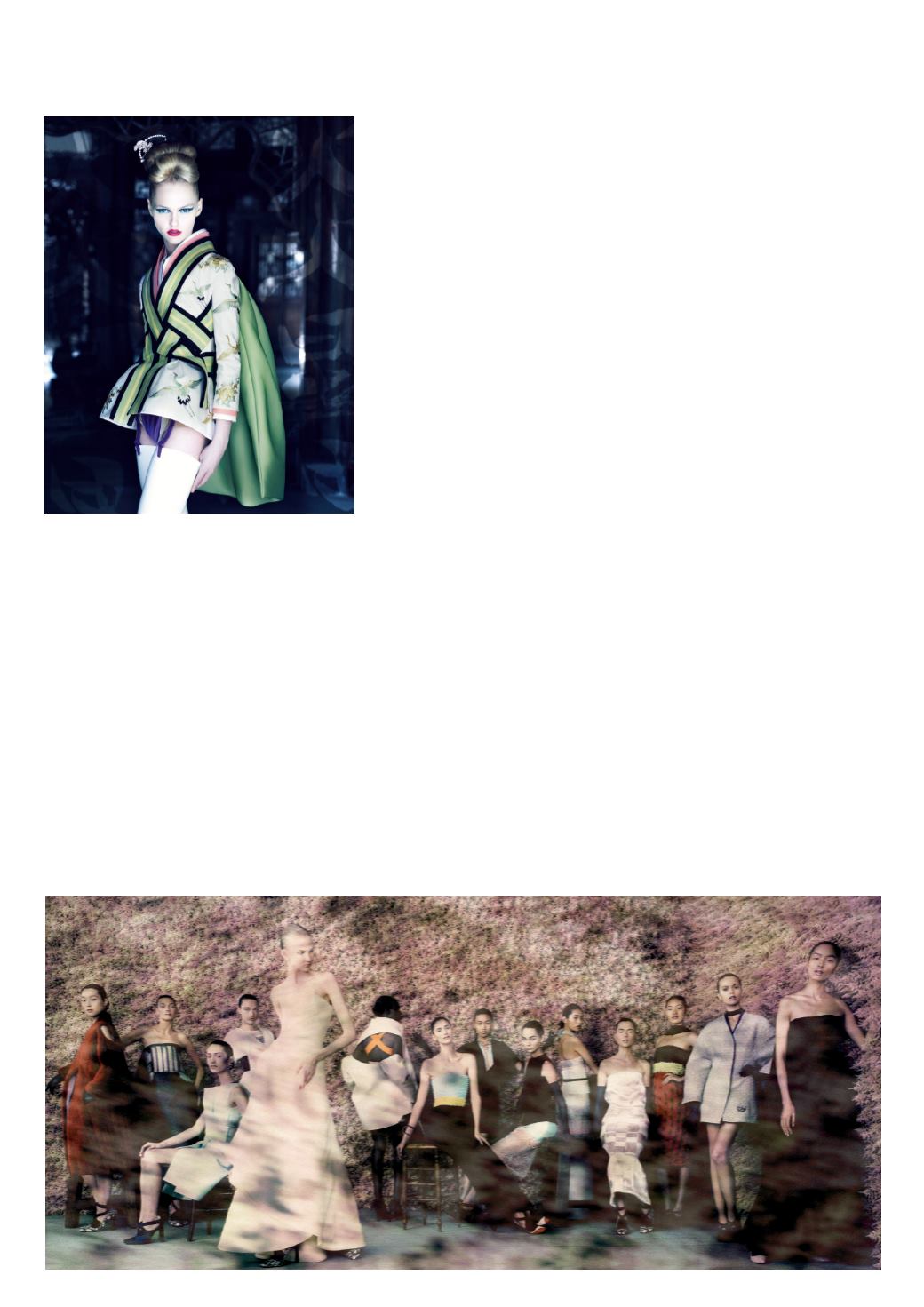
© Paolo Roversi Haute Couture automne-hiver 2013
© Patrick Demarchelier Haute Couture printemps-été 2007